About the Edo-Tokyo Traditional Performing Arts Festival
ABOUT US
The Edo Tokyo Traditional Performing Arts Festival, which will begin in 2025, will inherit the Tokyo Metropolitan Arts Festival, which has been popular for over half a century, and will be reborn as a festival specializing in traditional Japanese performing arts such as Noh theater, Japanese dance, traditional Japanese music, vaudeville performances, and folk performing arts.From full-scale stage performances to easy-to-participate, hands-on workshops, it will be enjoyable for a wide range of generations, from children to adults.
Inquiries about the Edo Tokyo Traditional Performing Arts Festival
Edo Tokyo Traditional Performing Arts Festival Executive Committee Secretariat
The second part is a behind-the-scenes story of the birth of the new work "Star Picking"! The worldview of Gagaku is fundamentally different from Western music. The unexpected connection between "stars" and Gagaku. And what is the psychology of the composer attending the premiere...?
The West and Japan have fundamentally different ideas.
-- What difficulties and joys did you encounter in composing your new work, "Hoshi-Picking"? I understand that this was your first time playing gagaku instruments
Tomoya Yokokawa (hereafter,Yokokawa): When I heard about the new commission, I was so happy I wanted to jump for joy. I'd always wanted to write a piece for gagaku... but honestly, as I studied the culture and theory of gagaku again, I felt a sense of awe at the idea of composing my own music. Gagaku has a truly ancient history, with a formal musical scale already established in ancient China (during the Shang and Zhou dynasties). In Japan, Japanese-style gagaku music theory was apparently compiled in the 800s. It has different scales and tones than Western music, and the sense of meter and rhythm is also different. For example, there is a subtle difference in pitch between the sound produced by the sho and the hichiriki. However, it is the clash of these differences that creates a beautiful sound. Learning that this discrepancy in pitch was born from a uniquely Japanese sense of pitch and aesthetics, and that it had been further refined and refined over many years, was deeply moving, and also made me feel humbled to be composing. European instruments have evolved to be able to produce all notes, or 12 notes, equally across all registers. However, the sho, on the other hand, has some bamboo tubes that have been stripped of their original reeds, rendering them soundless. I found this idea of restricting and reducing things in a very intriguing way. Seven-hole shakuhachi instruments were introduced for a time, but it's often said that five-hole instruments have a better tone. I feel that Japanese music has a fundamentally different approach to sound.
-- What was the process like when you actually started working on a new Gagaku piece?
Yokokawa: It was extremely difficult. After all, it's an instrument I've never composed for, so I'm still not sure if it will really sound the way I imagined it to.
-- In Germany, there are probably limited opportunities to see concerts and books about traditional Japanese music, so it must be difficult
Yokokawa: Yes, gathering information was the hardest part. When I was researching Noh, I would return to Japan for a short visit and buy a lot of related books and DVDs. Gathering information was also difficult when composing Gagaku music. I'm a composer, not a researcher, so I place the most importance on the process of how to transform various pieces of information into my own music. "How I feel" is important, but the limited information I could take in was very frustrating. Not being able to hear it live is very difficult. There are times when you reach the limits of your imagination.
Various techniques for composition —
--What else did you struggle with?
Yokokawa: For example, if you want a low note, you can usually add a low-pitched instrument, but in gagaku, the only instrument that can produce low notes is the biwa. However, because the biwa is a plucked string instrument, it cannot produce a sustained sound. It doesn't raise the bass level. So what can you do if you want a more dramatic sound? It was a constant process of trial and error. Another thing is that not all instruments can use all 12 chromatic scales, so when you want a certain sound, you can't get it. When I thought about what to do, I decided not to use that particular note, but to use a note close to the one I wanted and reinforce it with another instrument. Despite these limitations, or rather technical difficulties, new sounds were born through various ingenuity, and there were many moving moments. It was a difficult, but very enjoyable process.
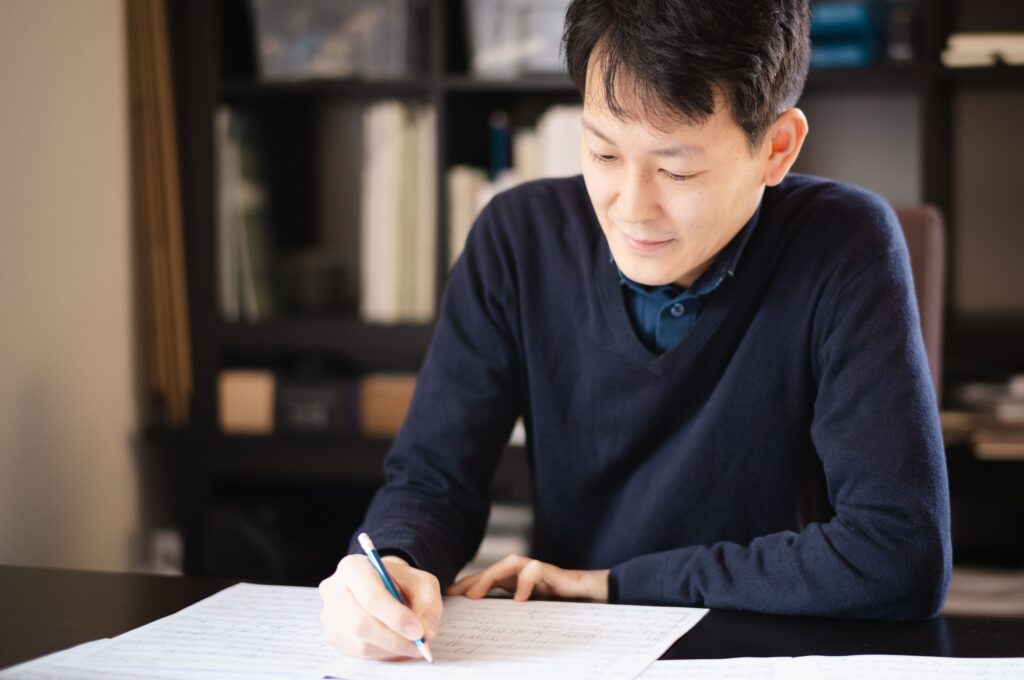
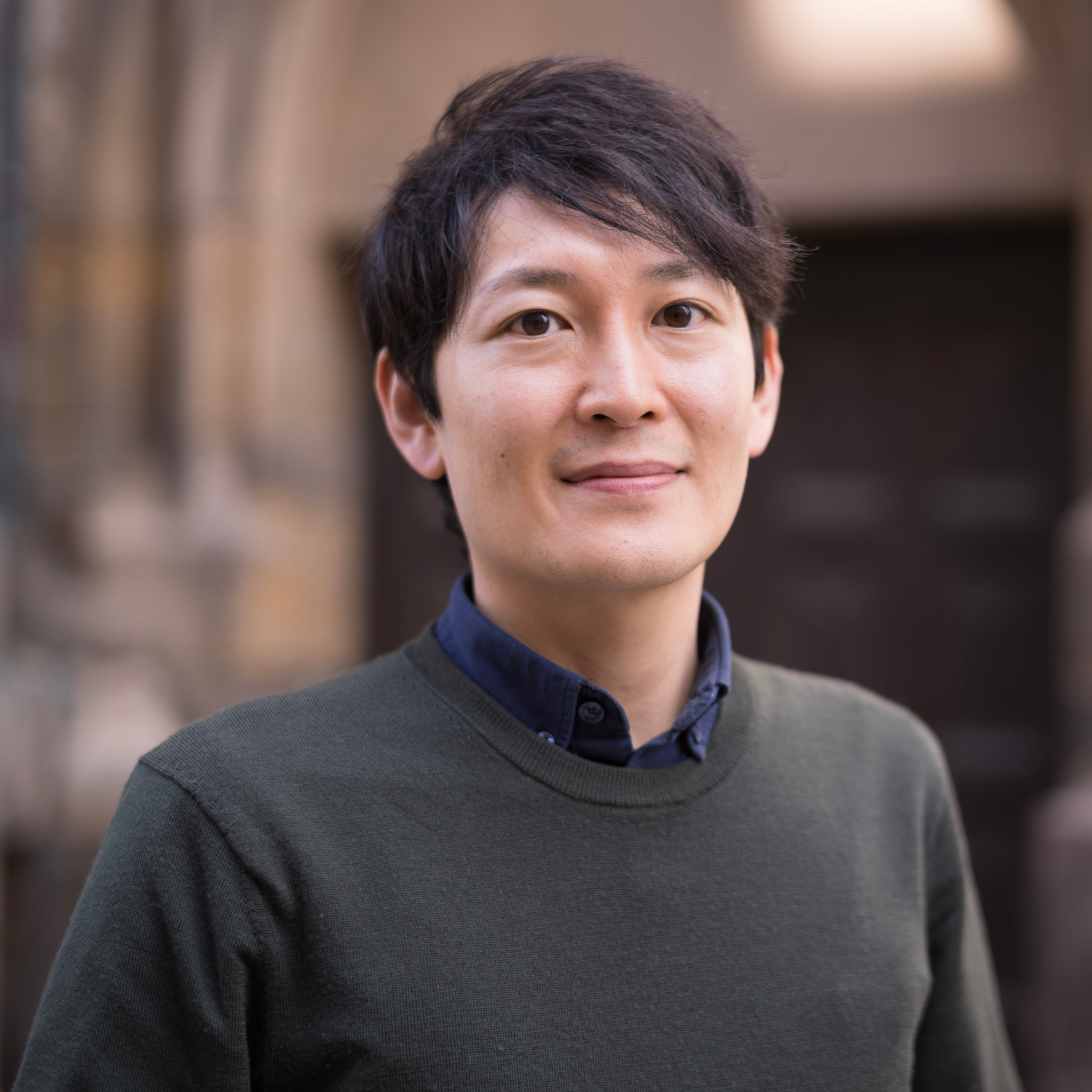
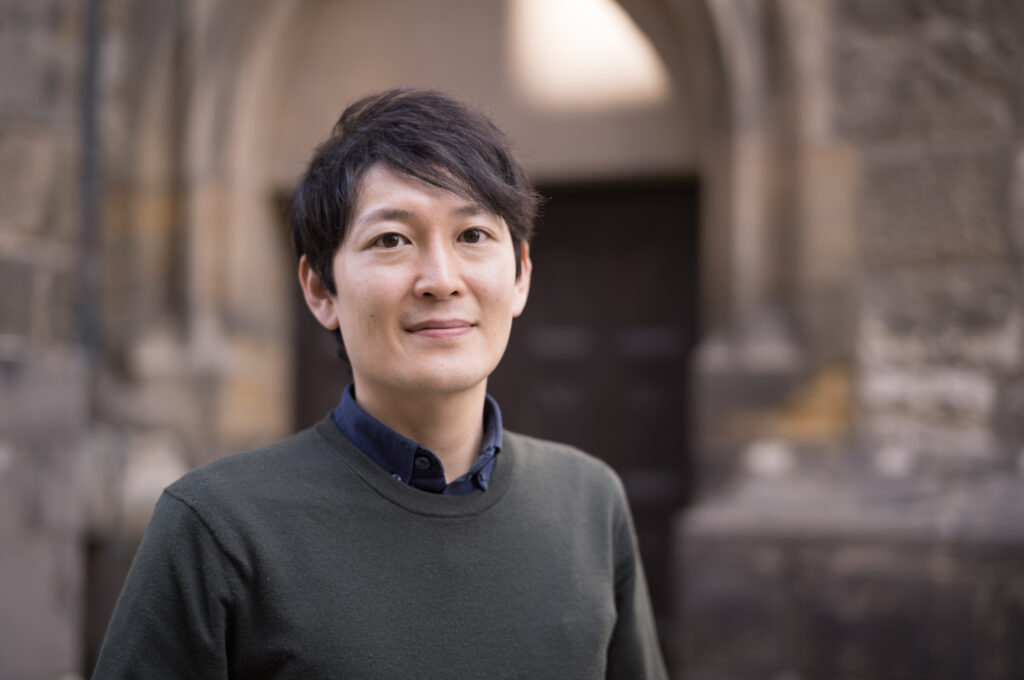
Composer Tomoya Yokokawa
Listen to the sound inside you —
--What kind of thoughts are behind the title "Star Picking"?
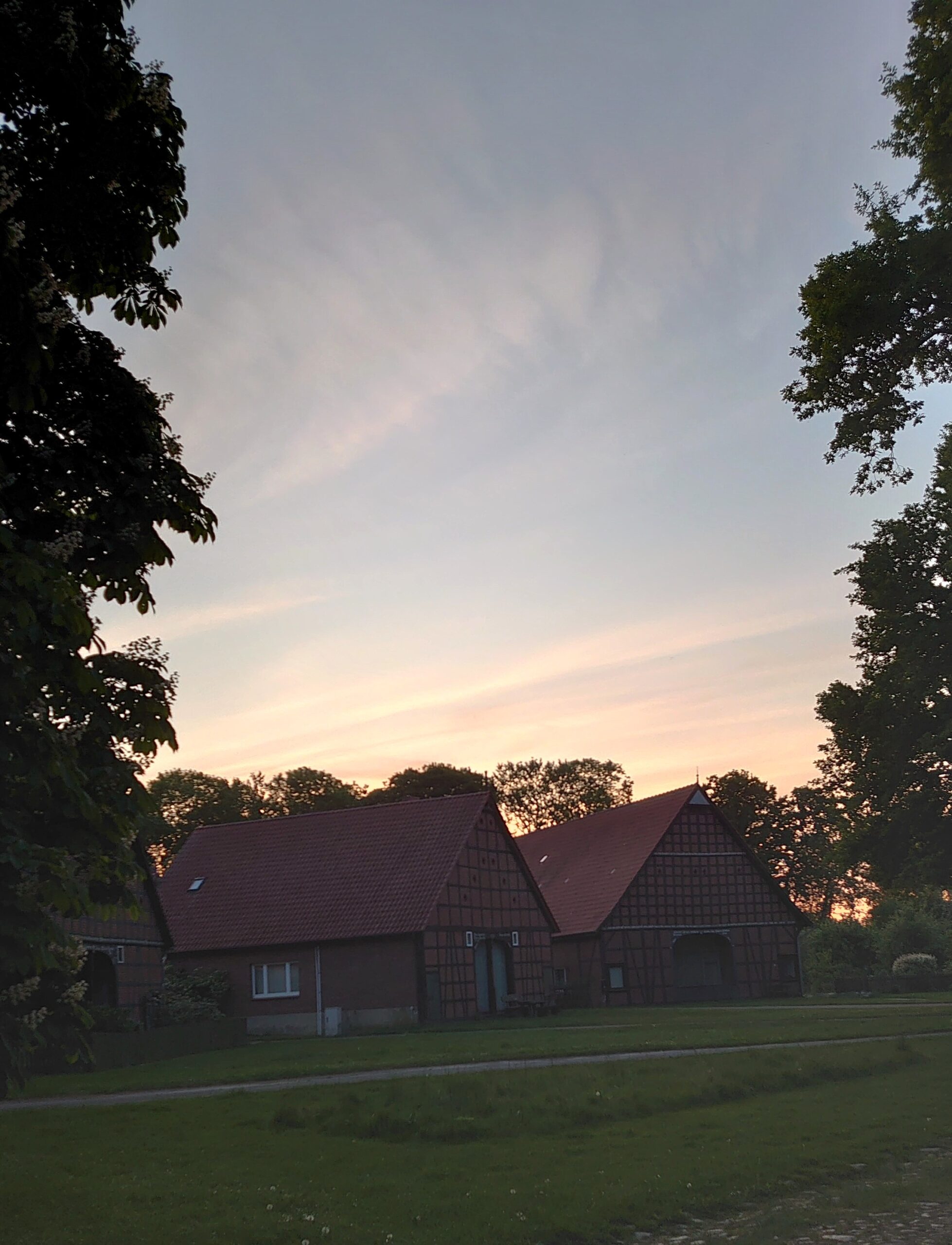
Yokokawa: I first had the desire to write a song with a star theme when I spent six months in 2025 staying in a small village called Schleiern in north-central Germany. There is an artist residency facility there, but there are almost no streetlights on the streets, and after 10pm the lights in the surrounding houses go out, leaving the place enveloped in pitch black darkness. It was the first time in my life that I had seen such a brilliantly shining starry sky. I felt like I had received some kind of powerful message.
Evening view of Schleiern
-- When I first heard the title "Picking Stars," I thought it was great. Gagaku music was primarily listened to by the emperor during the Heian period, and one theory is that while enjoying gagaku, people imagined the movement of celestial bodies. The repeated music represents the world continuing forever, the world turning, and by looking at it from a bird's-eye view, the movement of the celestial bodies and the world as it moves can be grasped in the palm of your hand. I felt that the title "Picking Stars" connected to this worldview
Yokokawa: Thank you. When I compose, I first spend a lot of time thinking about whether there's a sound flowing inside me. I compose as if I'm trying to grasp the sound that flows within me. I feel like that sound is born not from me, but from a dialogue with some other spiritual world. There's something sacred, a kind of spirituality to it. So, the time I spend composing is sacred and inviolable to me. And in order to grasp the sound, I place great importance on "listening." Even when listening to other people's music, I give it 100% of my effort, actively and proactively listening to the music. I think that has shaped my approach to composition. I believe traditional Kagura music also influenced "Hoshi-Gumi." When His Majesty the Emperor ascended to the throne, I watched a Kagura performance streamed on YouTube. The Kagura song echoed over the video of a large bonfire, and it gave me a sacred feeling. That feeling has remained deep in my heart and I feel it resonates in this song.
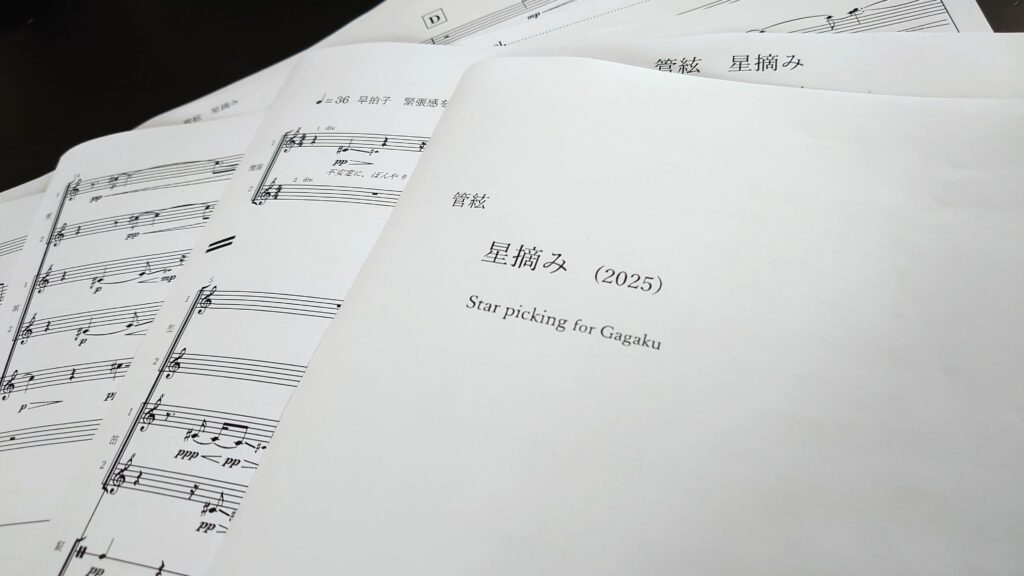
"Star Picking" score for Gagaku
When I attended the premiere —
-- Now, the premiere of "Star Picking" is fast approaching. How do you feel about being present at the premiere of a new work?
Yokokawa: To be honest, I'm very nervous (laughs). Whenever I attend a premiere, my heart starts beating hard, and it's really tough. Maybe this is something only a composer can feel. It's the same feeling as being present at a birth. I wonder if my child will be born safely, what kind of sound will resonate... it's a very complicated feeling. I 'm really grateful to the performers. I always feel that it's not something to be taken for granted that they are so actively involved in a new piece.
——Finally, please give us a message you would like to convey to your customers
Yokokawa: First of all, I'd be happy if you just dropped in without thinking too hard about it, and listened casually, noticing that there are things like this out there. As the world becomes increasingly globalized, I think we're living in an age where we're forced to think every day about what kind of country Japan really is. I live overseas, but I still feel anew the good things about my own country and the wonder of Japanese culture. I'm looking forward to seeing and feeling that at this concert.
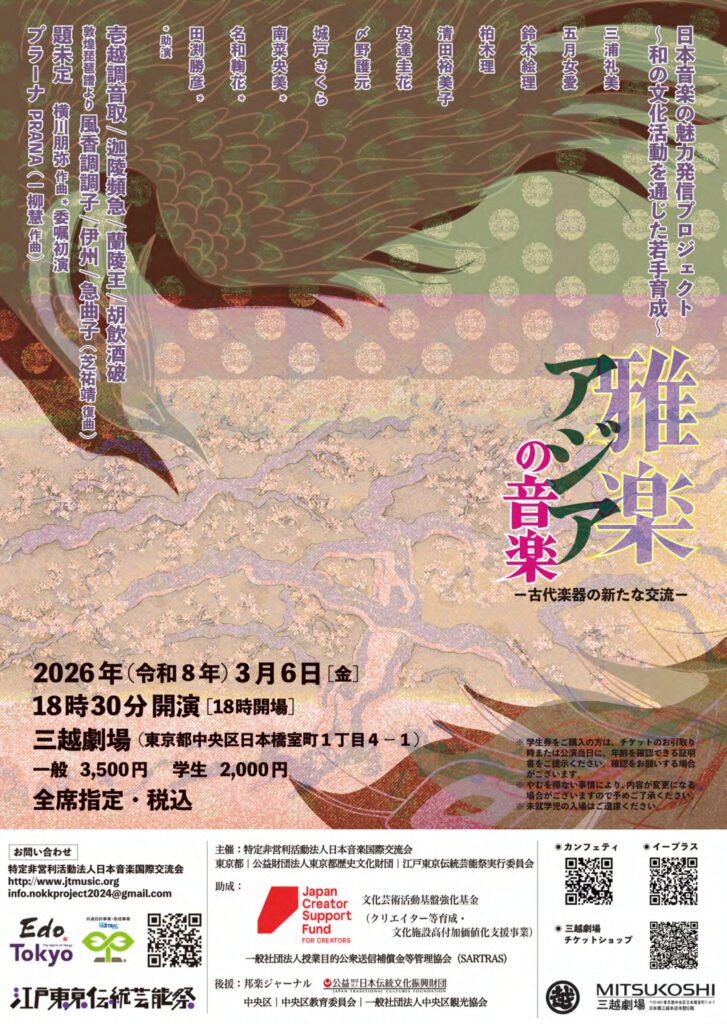
Gagaku and Asian Music : A New Exchange of Ancient Instruments
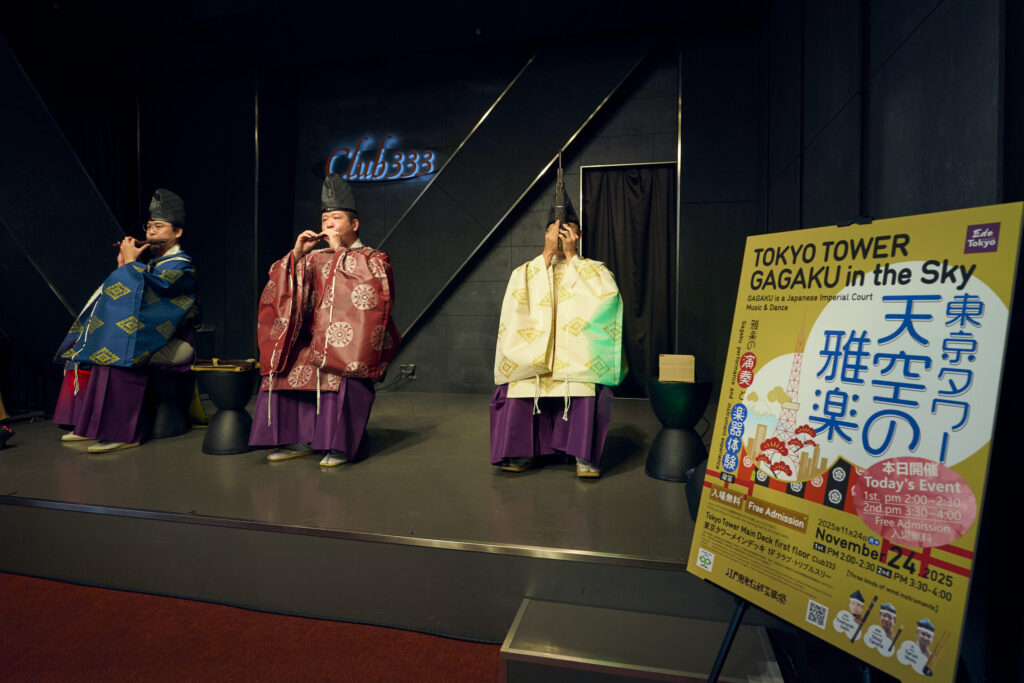
Gagaku music, introduced to Japan from the continent in ancient times and passed down for over a thousand years, will be performed by a group of young musicians, spanning time and space, from classical pieces to new works by contemporary composers. The program will open with classic masterpieces such as "Lanling King" and "Hu Drinking." This is gagaku! Enjoy the elegant sounds and dances that were performed at the Imperial Court during the Heian period. Next will be a rare performance of a rare piece. This piece was restored and composed based on a pipa score (dating from the 9th to 10th centuries) excavated at Dunhuang. The piece was restored by Shiba Sukeyasu (1935-2019), a musician at the Music Department of the Imperial Household Agency's Ceremonies Department and founding music director of Reigakusha. The second half of the program will begin with a new piece, "Hoshi-tsumi," by Yokokawa Tomoya (1988-). A young composer active in Europe will breathe new life into gagaku. It will be a moment of anticipation and tension as we witness a world premiere. The concert will conclude with "PRANA" by Toshi Ichiyanagi (1933-2022), one of the most representative postwar composers. The piece makes impressive use of a restored koto (harp) from the Shosoin Repository. The world of gagaku has spun a rich musical legacy across time and place. Please enjoy the performance to your heart's content.
Graduated from Tokyo Gakugei University in 2011. He has studied composition under Elena Mendoza, Klaus Lang, Masahiro Yamauchi, Shioji Kaneda, and Miyuki Shiozaki. In 2013, he traveled to Europe and completed his bachelor's degree at the University of the Arts in Graz with honors and his master's degree at the University of the Arts in Berlin with distinction. He won the international composition competitions Città di Udine (2023) and Torre Della Quarda (2018). He was also a finalist for the Claussen-Simon Composition Award (2023).